
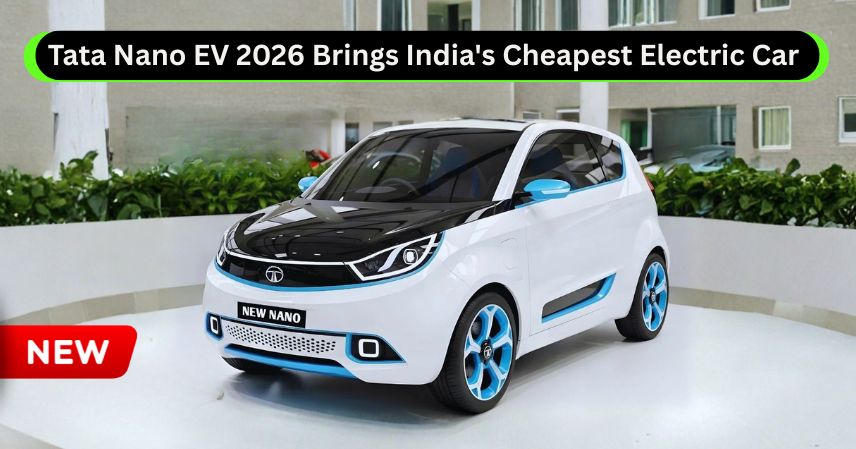
The Tata Nano, once famous as the world’s cheapest car, transformed India’s automotive landscape by making four-wheelers accessible to millions. Now, as India accelerates toward electric vehicles (EVs), Tata is set to revive this iconic tradition with the Tata Nano EV 2026—an affordable, compact, and practical electric car designed to tackle urban congestion and rising fuel costs.
The Legacy of Tata Nano and Its Shift to Electric
When first launched, the Tata Nano aimed to provide affordable transportation for Indian families. Although it struggled with adoption, the vision of democratizing mobility remains as relevant as ever. With the shift to electric technology, EVs are now a viable option due to their lower running costs, reduced maintenance, and government incentives. Turning the Nano into an electric car could finally fulfill Tata’s original mission—sustainable, accessible mobility for all.
Why the Nano EV 2026 Makes Sense in Today’s Market
India’s electric car market is growing quickly, but affordability is still a barrier. The Nano EV’s low price could make it the perfect solution for urban drivers, first-time buyers, students, and small families.
Key Drivers of Interest:
- Fluctuating petrol and diesel prices
- Compact size for city driving
- Growing environmental awareness
- Lower running and maintenance costs for EVs
- Government support and incentives
Designed for daily urban commuting—whether it’s getting to work, school, or the local market—the Nano EV 2026 is poised to be a practical choice for millions.
What to Expect from the Tata Nano EV 2026
Battery and Range
- Claimed range: 250–260 km per charge
- Battery: High-capacity 72V lithium battery
- Charging: Compatible with home AC charging
This range easily accommodates the typical urban commute of 40–50 km a day.
Urban Driving Experience
- Optimized for city speeds and quick acceleration
- Quieter, smoother rides
- Not intended for highway travel—perfect for dense city traffic
Expected Price and Affordability
- Projected price: ₹2.49 lakh to ₹2.99 lakh
- Potentially the most affordable EV in India, cheaper than many petrol hatchbacks when considering total cost of ownership
Ownership Benefits:
- Extremely low running costs
- Minimal maintenance compared to internal combustion engine (ICE) vehicles
- Eligibility for government grants and incentives
Accessible to lower- and middle-income families
Design Philosophy: Compact and Functional
Expect a small yet modern design, making it:
- Easy to maneuver and park in crowded urban areas
- Energy efficient, maximizing range with a lighter build
- Stylish yet practical for everyday use
Smart Features and Technology
Despite its affordability, the Nano EV 2026 is expected to include essential smart features:
- Digital instrument cluster
- Smartphone connectivity
- Regenerative braking
- Power windows
- Remote diagnostics via mobile app
Tata’s reputation for quality even in budget cars suggests the Nano EV will feel modern, not barebones.
Safety and Build Quality
Tata Motors has improved its safety standards over the years. The Nano EV will likely include:
- Sturdy body construction
- Front seat belts with reminders
- Improved braking systems
- Basic electronic safety features
This will make it safer than many older, cheaper vehicles and two-wheelers.
Who Should Consider the Tata Nano EV 2026?
The Nano EV is tailored for city dwellers, especially:
- First-time car buyers
- Two-wheeler owners upgrading to a car
- College students and young professionals
- Daily city commuters
- Urban families needing a second vehicle
For many, it could be the most affordable step up from a scooter to a car.
Can the Nano EV Make Electric Mobility Mainstream in India?
If Tata delivers on its promises for price and range, the Nano EV could dramatically accelerate EV adoption in India.
Potential Impact:
- Millions could switch to electric vehicles
- Reduced urban pollution
- Expansion of EV infrastructure
- Increased competition, forcing lower prices across the market
- Positioning the Nano EV as a symbol of clean, affordable urban transport
Comparing the Nano EV to Other Affordable EVs
While most affordable EVs in India are two- or three-wheelers, the Nano EV offers:
- Lower cost than most electric cars
- Greater safety than scooters
- More comfort than rickshaws
- Lower total ownership costs
This unique position could allow Tata to dominate the entry-level EV market.
Tata Motors: Building Trust in EVs
Tata Motors’ established EV presence, with models like the Tiago EV and Nexon EV, strengthens its credibility. Key strengths include:
- India’s leading EV manufacturer
- Strong government and industry backing
- Reliable after-sales network
- Advanced battery technology
- Transparent pricing
Conclusion
The Tata Nano EV 2026 is more than just an affordable car—it’s a step towards cleaner, more inclusive transportation. If Tata Motors balances price, range, and reliability, the Nano EV could fulfill the original Nano’s vision in a modern, sustainable way, bringing electric mobility to millions of Indian households and reshaping urban travel for the future.
FAQs
Expected launch: 2026 (no official date yet).
Estimated price: ₹2.49 lakh to ₹2.99 lakh.
Claimed range: 250–260 km per charge.
No, it’s primarily designed for city and suburban use.
If launched at the projected price, yes.