
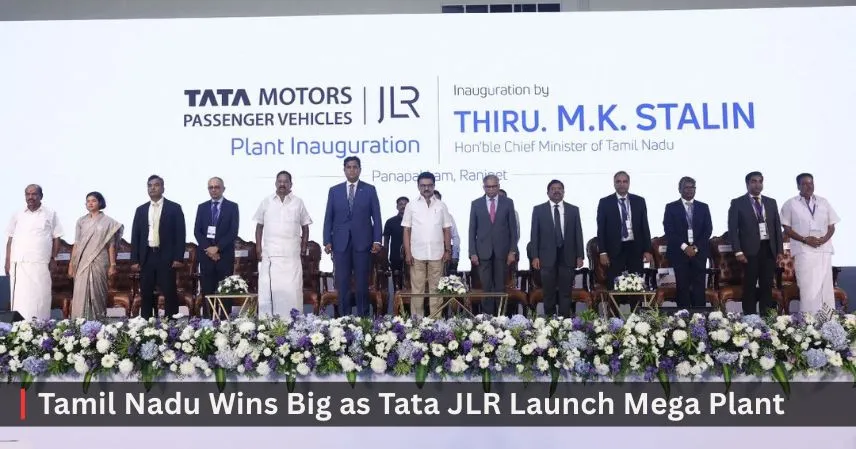
The launch of Tata Motors’ new Panapakkam facility in Tamil Nadu marks a significant turning point in India’s automotive landscape. The first vehicle to roll out from this plant is the Range Rover Evoque, highlighting the growing collaboration between Tata Motors and Jaguar Land Rover (JLR).
Panapakkam Plant: More Than Just a Factory
This isn’t just another manufacturing site. The Panapakkam facility is designed as a comprehensive ecosystem capable of producing luxury vehicles, electric vehicles (EVs), and more. Its establishment underscores India’s rising importance in the global automotive supply chain and supports Tata Motors’ long-term goals.
Key Highlights of the Panapakkam Facility
- Location: Tamil Nadu, India
- Operations Begin: 2026
- First Model Produced: Range Rover Evoque
- Production Capabilities: Multi-platform (ICE and EV-ready)
- Job Creation: Over 5,000 direct and indirect opportunities at full capacity
While Tata Motors hasn’t specified the exact production numbers, industry experts anticipate a significant boost in high-end vehicle output, meeting both domestic and international demand.
Why This Plant Matters to India's Auto Sector
India’s role in global manufacturing is expanding as automakers seek alternatives to traditional production hubs due to geopolitical and supply chain challenges. The Panapakkam plant exemplifies this shift, enabling:
- Reduced reliance on imports
- Lower production costs
- Improved delivery times
- Increased local content
- Enhanced export readiness
This move could make luxury vehicles more accessible to Indian consumers and potentially lower their prices.
India: A Crucial Player in JLR’s Global Network
Previously, the Evoque was assembled in India as a Completely Knocked Down (CKD) kit. Now, with a purpose-built facility, Tata Motors and JLR can efficiently produce luxury and Tata-branded vehicles together, bringing several advantages:
- Reduced global shipping risks
- Lower market entry costs
- Higher regional profitability
- Quicker market responsiveness
With Indian demand for high-end urban mobility rising, India is poised to become a key export hub for compact luxury SUVs.
Shared Infrastructure: Maximizing Efficiency
The joint production infrastructure at Panapakkam allows Tata Motors and JLR to benefit from:
- Economies of scale
- Shared capital investment
- Accelerated product launches
- Enhanced operational safety
The plant’s modular, next-generation platforms support both ICE and EV models, aligning with the industry trend toward platform sharing.
Flexibility for the Future: Ready for Electrification
The Panapakkam plant is built with future mobility in mind, supporting:
- Conventional gas-powered vehicles
- Hybrid technologies
- Electric vehicle batteries
This flexibility ensures the plant can adapt to changing consumer preferences and stricter environmental standards.
Strategic Alignment with Tata Motors’ EV Vision
Already a leader in India’s EV market, Tata Motors can scale up electric vehicle production quickly thanks to the plant’s adaptable design. Meanwhile, JLR is advancing its global lineup of high-end electric cars, and local manufacturing will make Indian market entry easier.
Boosting Tamil Nadu’s Automotive Ecosystem
Often called the “Detroit of India,” Tamil Nadu’s reputation as an automotive hub is further enhanced by the Panapakkam facility, which brings:
- Over 5,000 new jobs
- Growth for supporting industries
- Expansion of supplier networks
- Infrastructure development
- Increased local economic activity
Tata’s Lakshya program will also upskill workers for the future of automotive manufacturing.
Supplier Localization: Building a Robust Network
A strong local supplier network is essential for modern car manufacturing. The Panapakkam project aims to increase regional parts production, offering:
- Lower manufacturing costs
- More reliable supply chains
- Shorter production cycles
- Greater resilience to global disruptions
Tata–JLR: From Acquisition to Strategic Partnership
Since acquiring JLR in 2008, Tata Motors has evolved from cost-saving measures to a deep strategic alliance. The Panapakkam facility cements India’s role as a core part of Tata-JLR’s global production.
Future-Ready Investment: Industry Trends
Industry experts agree that Panapakkam’s development is well-aligned with key automotive trends:
- Growing demand for luxury SUVs
- Accelerated EV adoption
- Diverse production strategies
- Platform engineering
- Globalized, multi-location manufacturing
This all-in-one approach keeps Tata Motors and JLR agile in a rapidly changing market.
What Customers Stand to Gain
While immediate changes for consumers may be subtle, the benefits will increase over time, including:
- Faster model availability
- Improved product quality
- Access to advanced technologies
- Price stability
- More EV options
- Quicker access to global models
Risks and Challenges
Large industrial projects always face risks, such as:
- Technological shifts
- Price fluctuations
- Supply chain uncertainties
- Regulatory changes
The Panapakkam plant’s flexible design helps mitigate these issues by adapting production to evolving market demands.
India’s Rising Status as a Global Auto Hub
The Panapakkam complex is more than an economic investment—it’s a symbol of India’s emergence as a key player in global automotive manufacturing, driven by:
- Competitive development costs
- Skilled workforce
- Government incentives
- Infrastructure investment
Strong domestic demand
Looking Ahead
The Panapakkam plant is poised to shape Tata Motors’ and JLR’s future strategies, potentially leading to:
- More JLR models produced locally
- Increased EV manufacturing
- Expanded exports
- Adoption of advanced digital factory systems
This facility is built not just for today’s needs, but for the next decade of innovation and growth.
Conclusion
The opening of Tata Motors’ Panapakkam plant marks a major milestone for India’s automotive industry. By moving high-quality production closer to home, Tata Motors and JLR are building a robust, scalable, and future-ready manufacturing foundation.
As the industry evolves toward electrification and more resilient supply chains, forward-thinking facilities like Panapakkam will be vital. India is not just participating in the global automotive sector—it is helping to lead it into a new era.
FAQs
2026.
Range Rover Evoque.
Yes, it supports ICE, hybrid, and electric vehicle production.
Over 5,000 direct and indirect jobs at full capacity.
It reduces production costs, boosts regional output, and supports electrification.
Greater choice, access to new models, and potentially lower prices.