
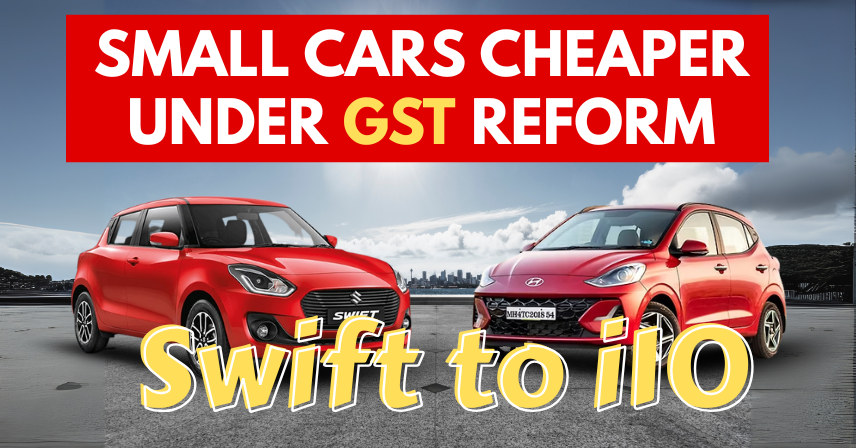
New GST reform makes small cars like Maruti Swift, Hyundai i10, and more affordable in India. Explore price impact, benefits, and future market trends.
India’s automobile industry is witnessing a game-changing reform. The recent GST (Goods and Services Tax) amendment has brought cheer to millions of car buyers, especially those planning to purchase small cars. Popular models like the Maruti Suzuki Swift, Hyundai Grand i10, Tata Tiago, and Renault Kwid are now set to become more affordable.
This tax relief comes as part of the government’s broader plan to boost the auto sector, encourage sustainable mobility, and make personal transportation more accessible. For families and young professionals, this means lower upfront costs, reduced EMIs, and higher savings.
In this detailed blog, we will break down:
- What the new GST reform means for car buyers
- Which small cars are affected
- Price impact on Swift, i10, and others
- Benefits for buyers and the auto industry
- Long-term outlook for India’s car market
Understanding GST on Automobiles in India
Before diving into the reform, it’s important to understand how GST applies to vehicles.
- Earlier Tax Regime (before reform): Small cars attracted a GST of 28% plus a cess of 1-3%, depending on engine size.
- New GST Reform (2025 update): The cess on small cars under 1200cc petrol and 1500cc diesel engines has been either reduced or removed. This directly lowers the on-road price.
By targeting small cars, the government aims to:
- Boost middle-class affordability
- Encourage first-time buyers
- Reduce dependency on two-wheelers for family travel
- Revive sales in the entry-level car segment
How Much Cheaper Will Small Cars Get?
The price cut will vary across brands and models but estimates suggest that small cars could see a reduction of ₹30,000 to ₹70,000, depending on the variant.
Example Price Impact:
- Maruti Suzuki Swift
- Old Price (Approx): ₹6.5 lakh
- New Price After GST Reform: ₹6.0 – ₹6.2 lakh
- Savings: ₹30,000 – ₹40,000
- Old Price (Approx): ₹6.5 lakh
- Hyundai Grand i10 Nios
- Old Price (Approx): ₹5.9 lakh
- New Price After GST Reform: ₹5.4 – ₹5.6 lakh
- Savings: ₹35,000 – ₹40,000
- Old Price (Approx): ₹5.9 lakh
- Tata Tiago
- Old Price (Approx): ₹5.6 lakh
- New Price After GST Reform: ₹5.1 – ₹5.3 lakh
- Savings: ₹30,000 – ₹35,000
- Old Price (Approx): ₹5.6 lakh
- Renault Kwid
- Old Price (Approx): ₹4.8 lakh
- New Price After GST Reform: ₹4.3 – ₹4.5 lakh
- Savings: ₹25,000 – ₹30,000
- Old Price (Approx): ₹4.8 lakh
- Maruti Alto K10
- Old Price (Approx): ₹4.3 lakh
- New Price After GST Reform: ₹3.9 – ₹4.0 lakh
- Savings: ₹20,000 – ₹25,000
- Old Price (Approx): ₹4.3 lakh
Why This Reform is a Game-Changer
1. Affordability for Middle-Class Families
With reduced taxes, more families can now afford to upgrade from two-wheelers to entry-level hatchbacks, ensuring better safety and comfort.
2. Boost to First-Time Buyers
Young professionals and college graduates now find it easier to buy their first car without overstretching budgets.
3. Stronger Auto Industry Growth
Small cars form the backbone of India’s passenger car market. With sales revival, manufacturers will witness stronger demand.
4. Financing Becomes Easier
With reduced ex-showroom prices, EMIs and down payments automatically drop, making car loans more attractive.
5. Encouragement for Local Manufacturing
Lower taxes mean higher volumes, pushing automakers to increase local production and create more jobs.
Brands That Benefit the Most
- Maruti Suzuki – Being India’s largest carmaker with best-sellers like Swift, Alto, WagonR, and Baleno, Maruti stands to gain the maximum.
- Hyundai – Its i10 and i20 series attract first-time buyers, and this tax cut will only increase volumes.
- Tata Motors – Tiago and Punch are positioned perfectly in the affordable segment.
- Renault & Nissan – Kwid and Magnite (lower variants) will become more attractive.
- Kia & Toyota – Their compact offerings also benefit from reduced GST slabs.
Impact on the Automobile Market
- Higher Sales in Tier-2 and Tier-3 Cities: Affordability will boost car penetration in semi-urban and rural India.
- Shift from Two-Wheelers to Cars: Many two-wheeler users may now consider upgrading to a small car.
- Competitive Market: With reduced costs, automakers may launch new models to capture the growing market.
- Resale Value Impact: Small cars may retain better resale value as demand rises.
Challenges Ahead
While the reform is positive, there are still challenges:
- Rising fuel prices can offset savings.
- EVs and hybrid incentives might overshadow small petrol cars.
- Automakers need to balance costs while maintaining profitability.
Future of Small Cars in India
The GST reform clearly indicates the government’s focus on mass mobility and affordability. However, the future may see a shift towards electric hatchbacks with similar tax benefits. Models like Tata Tiago EV and MG Comet are already showing promise.
This reform is not just about cheaper cars but about driving India towards higher car ownership, safer roads, and a modernized transport ecosystem.
Conclusion
The new GST reform has unlocked fresh opportunities for car buyers and manufacturers alike. With small cars like Maruti Swift, Hyundai i10, Tata Tiago, and Renault Kwid becoming significantly cheaper, India’s middle class can now dream bigger without burning a hole in their pocket.
The reform will not only revive the struggling small car market but also encourage millions of two-wheeler users to transition to safer and more comfortable cars.
For buyers, it’s the perfect time to step into the world of four-wheelers. And for the auto industry, it’s the much-needed push to accelerate growth.
👉 For more updates like this, visit www.carbikebhp.com