
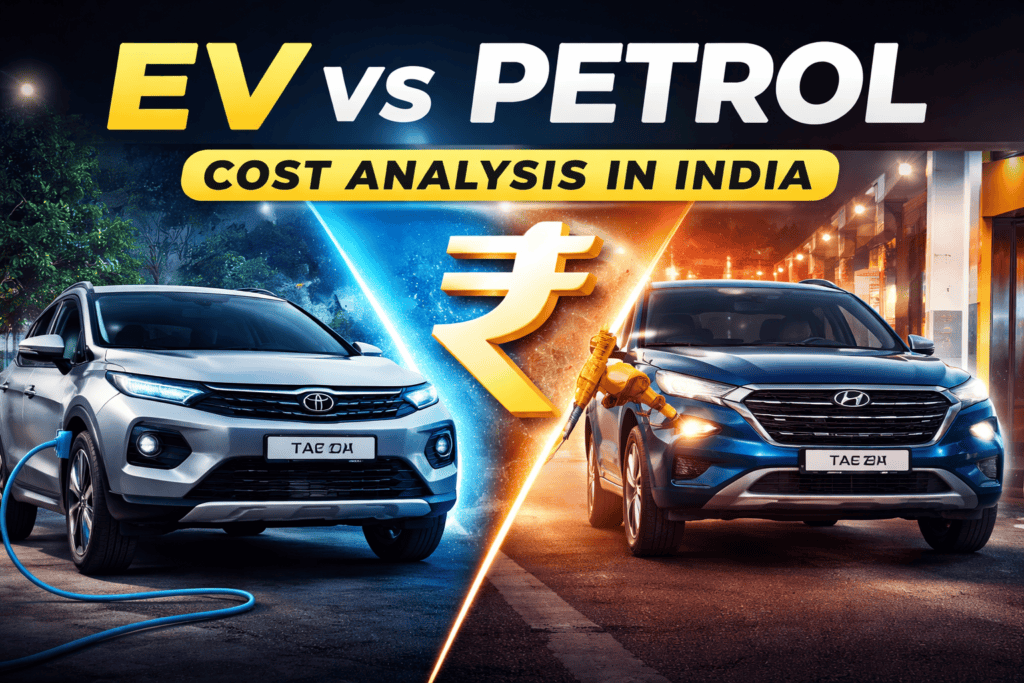
If you strip away the marketing noise, the EV vs petrol debate in India comes down to one simple question. What does it actually cost you to live with the car every day?
Most comparisons you see online rely on ideal conditions. Perfect mileage figures, flat electricity rates, and zero behavioural variation. That is not how Indian car ownership works. Traffic conditions, driving style, charging habits, and even your city play a huge role in determining the real cost.
So instead of theory, let’s break this down the way a serious buyer should look at it. Real numbers, real scenarios, and long-term ownership impact.
EV vs Petrol Cars -The Starting Point Realistic Assumptions
To make this comparison meaningful, we need a fair baseline. Not luxury EVs versus entry-level petrol cars, but comparable segments.
For this analysis, we are taking a mid-size SUV benchmark because that is where maximum demand currently exists in India.
On the electric side, think of something like the Tata Nexon EV. On the petrol side, a typical reference would be the Hyundai Creta.
Now let’s establish real-world numbers, not brochure claims.
A Nexon EV in daily use will realistically deliver around 280 to 320 km depending on driving style, AC usage, and terrain. We are taking a safe average of 300 km from a roughly 40 kWh usable battery.
Electricity cost varies city to city, but for most urban users charging at home, Rs 7 to Rs 9 per unit is realistic. We will work with Rs 8.
On the petrol side, a Creta petrol will return around 13 to 15 km per litre in mixed driving. We will assume 15 km only to keep the comparison fair. Petrol prices hovering around Rs 100 per litre is again a realistic national average.
Now we can start talking numbers.
What It Costs You Per Kilometre
This is the foundation of the entire comparison, because everything else builds on this.
For the EV, if 40 units of electricity give you roughly 300 km, your total cost for a full charge is about Rs 320. That brings your running cost to roughly Rs 1.1 per km.
Now here is where nuance matters. If you rely on public fast chargers, especially on highways or in commercial setups, your cost per unit can jump to Rs 12 to Rs 18. That pushes your running cost closer to Rs 2.5 to Rs 3 per km. Still cheaper than petrol, but the gap narrows.
For petrol, the math is straightforward but brutal. At Rs 100 per litre and 15 km per litre efficiency, you are spending about Rs 6.6 per km. In real city traffic, that can easily go beyond Rs 7.5 without you even realizing it.
What this means in practical terms is that every kilometre you drive in a petrol car costs you roughly five to six times more than an EV if you are charging at home.
Monthly Running Cost Where the Difference Becomes Real
Let’s translate that into actual ownership for EV vs Petrol Cars.
A typical urban user in India drives somewhere between 800 to 1,200 km per month. Let’s take a clean 1,000 km number.
With an EV, you are spending roughly Rs 1,100 to Rs 1,500 depending on charging mix.
With a petrol car, you are spending Rs 6,500 to Rs 7,000 for the same usage.
That is not a small difference. That is the difference between a fuel bill you don’t think about and one you actively track.
Now stretch this to 2,000 km a month, which is common for sales professionals or frequent travellers within a city cluster. Your EV cost moves to around Rs 2,500. Your petrol cost crosses Rs 13,000.
This is where EVs start making a very strong financial argument.
The Bigger Picture Annual and Five Year Ownership
A lot of buyers underestimate how quickly these savings add up.
At a conservative level, if you are saving around Rs 5,000 per month, that is Rs 60,000 per year. For higher usage users, this can go beyond Rs 1 lakh annually.
Over five years, you are looking at savings between Rs 3 lakh to Rs 5 lakh. That is not theoretical. That is actual money you would have otherwise spent on fuel.
This is the primary reason EV vs Petrol adoption is accelerating among high-mileage users first. Fleet operators, daily commuters, and city-heavy users see the benefit almost immediately.
The Upfront Cost Problem and Break Even Reality
Now we address the biggest hesitation point for EV vs Petrol Cars.
EVs still cost more upfront. In most comparable segments, you are paying a premium of Rs 2 lakh to Rs 4 lakh over a petrol car.
So the real question is not whether EV is cheaper to run. It is how long it takes to recover that extra cost.
If your annual savings are around Rs 70,000, your break-even point sits around four to five years. If your usage is higher, you reach break-even faster. If your usage is low, it stretches longer.
This is why EVs are not a universal recommendation yet. They are highly dependent on how much you drive.
Hidden Costs That Change the Equation
This is where most articles oversimplify things.
On the EV side, your biggest additional cost is setting up home charging. Depending on your setup, wiring, and installation complexity, this can cost anywhere between Rs 50,000 and Rs 1 lakh.
Public charging, as discussed earlier, is also more expensive and can eat into your savings if used frequently.
Battery degradation is another concern, but in practical terms, most manufacturers now offer 8-year warranties, which covers typical ownership cycles.
On the petrol side, the hidden costs are less visible but very real. Regular servicing, oil changes, filters, clutch wear, and engine-related issues add up over time. These are not large one-time expenses but recurring ones.
Fuel price volatility is another factor. Electricity tariffs do increase, but nowhere near the unpredictability of petrol pricing in India.
Maintenance Cost Difference What Owners Actually Experience
EVs are mechanically simpler. No engine, no gearbox complexity in the traditional sense, and fewer moving parts.
This translates to lower servicing frequency and lower maintenance bills. Most EV owners report minimal servicing costs beyond basic checks and consumables like tyres and brake pads.
Petrol cars, on the other hand, come with a predictable but higher maintenance cycle. Even if nothing goes wrong, regular servicing is unavoidable.
Over five years, the maintenance cost gap further strengthens the EV case.
Real World Usage Where Each One Makes Sense
If your driving is mostly within city limits, predictable, and under 50 km per day, EV ownership becomes extremely easy. You charge overnight, wake up to a full battery, and rarely think about running cost.
If you are someone who frequently does long highway drives, especially in regions where charging infrastructure is still patchy, petrol still offers unmatched convenience.
For mixed usage, EVs work, but only if you are willing to plan your longer trips. Charging stops, route planning, and time management become part of the experience.
Infrastructure Reality Check India in 2026
Charging infrastructure has improved significantly, especially in metro cities and major highways. But it is not yet at the level of fuel stations.
In cities like Delhi, Mumbai, Bangalore, and Hyderabad, EV ownership is already practical. In Tier 2 cities, it depends heavily on local infrastructure.
Highway charging is improving, but reliability and availability still vary by route.
The Final Verdict A Practical Buyer’s View
There is no one-size-fits-all answer here for EV Vs Petrol Cars.
If your usage is predictable, city-focused, and you have access to home charging, an EV is financially and practically the smarter choice today.
If your driving involves frequent long-distance travel, unpredictable routes, or limited charging access, petrol still makes more sense.
If you are someone who keeps cars for a short period, say three years or less, the financial advantage of EVs may not fully materialize.
But if you are planning long-term ownership, the numbers clearly tilt in favour of electric.
Straight Advice from the Ground
Do not buy an EV because it is the future. Buy it because it fits your present usage.
Do not avoid EVs because of range anxiety without understanding your actual driving pattern.
The smartest buyers today are not choosing sides. They are choosing based on data.