
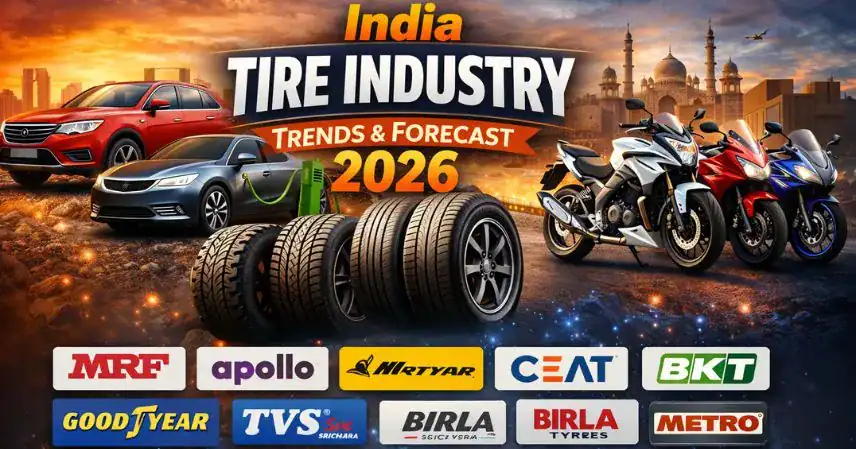
The tire industry forms a crucial pillar of India’s dynamic automotive sector. Supporting everything from compact cars and SUVs to heavy-duty trucks, two-wheelers, and off-road vehicles, tire manufacturers serve diverse needs across varied terrains. As we look ahead to 2026, the industry is geared for a new era of technological progress and international competition, driven by rising vehicle ownership, expanding infrastructure, robust rural mobility, and the surging adoption of electric vehicles.
Market Size and Growth Rate in 2026
Steady Growth Over the Decade
The Indian tire market has demonstrated consistent growth over the past ten years. In FY2025, total tire sales reached approximately 210 million units, with an annual growth rate between 8% and 10%.
Sales Forecast for FY2026
- Projected Sales Volume: 225–235 million units
- Expected Annual Growth Rate: 9%–11%
- Predicted Export Growth: 12%–15%
- Growth Drivers: Strong replacement demand and contracts with original equipment manufacturers (OEMs)
Segment-wise Sales Breakdown
Passenger Vehicle Tires
- Market Share: 28%–30% of total volume
- FY2025 Sales: ~60 million units
- Expected FY2026 Growth: 10%
- Trends: Increasing SUV demand and preference for premium tires
Commercial Vehicle Tires
- Radialization: Radial tires now hold 25%–27% market share, with over 50% penetration in trucks
- Forecasted Growth (FY2026): 8%
- Growth Factors: Infrastructure investments and freight movement
Two-Wheeler Tires
- Largest Volume Segment: Nearly 40% market share
- FY2025 Sales: ~85 million units
- Expected Growth (FY2026): 7%–9%
- Key Drivers: Urban commuting and rural expansion
Specialty and Off-Road Tires
- Growth Rate: 10%–12%
- Export Contribution: Increasing steadily
- Demand Drivers: Infrastructure and mining projects
Technological Transformation: Radialization and Innovation
Rise of Radial and Tubeless Tires
Radial tires have delivered significant improvements in fuel efficiency, load capacity, durability, grip, and stability, lowering operating costs for fleet operators. Consumer trends now favor:
- Tubeless tires for safety and convenience
- All-weather tread patterns
- Performance-oriented SUV tires
- Low rolling resistance compounds
These innovations reflect growing demands for performance and long-lasting tires on Indian roads.
The Electric Vehicle (EV) Tire Revolution
Electric vehicles are reshaping tire design and manufacturing. EVs require:
- Low-noise operation
- High-grip compounds
- Reinforced sidewalls
- Reduced rolling resistance
- Enhanced torque handling
Manufacturers are investing in silica-based rubber and eco-friendly processes. By 2026, EV-specific tires are expected to represent 5%–7% of total passenger vehicle tire sales.
Commitment to Green Manufacturing and Sustainability
Indian tire makers are prioritizing:
- Eco-friendly raw materials
- Reduced carbon emissions
- Energy-efficient production
- Water recycling initiatives
Retreading remains widespread for commercial vehicles, with over 50% penetration in the truck segment, making India one of the world’s largest retread markets.
India’s Tire Export Performance
India has emerged as a leading tire exporter, particularly to:
- The United States
- Europe
- Middle East
- Africa
Exports account for 25%–30% of total production, with 12%–15% growth expected in 2026. Competitive manufacturing, affordable labor, and increasing quality standards have bolstered India’s global position.
Top Tire Manufacturers in 2026
Leading companies driving the Indian tire industry include:
- MRF Tires
- Apollo Tires
- JK Tyre and Industries
- CEAT Limited
- Balkrishna Industries
- Goodyear India
- TVS Srichakra
- Birla Tires
- Metro Tyres
- Kesoram Industries
- Bridgestone India
- Maxxis Rubber India
- Ralson India
- Modi Tyre Company
- Yokohama India
These manufacturers supply both OEMs and replacement markets across all vehicle segments.
OEM vs. Replacement Markets
- OEM Market: 35%–40% of total sales, driven by vehicle production
- Replacement Market: 60%–65% of total sales, higher margins, and the primary revenue source
Factors Fueling Growth in 2026
- Rising SUV ownership
- Expanding highway and road networks
- Growing electric vehicle adoption
- Increased rural mobility
- Surging freight and logistics activity
Key Challenges Ahead
Despite rapid growth, the industry faces:
- Volatile rubber prices
- Global supply chain uncertainties
- Anti-dumping duties in export markets
- Intensifying international competition
Effective cost management and innovation will be critical to maintaining margins.
Looking Beyond 2026
The Indian tire industry is projected to:
- Exceed 250 million units in annual sales
- Achieve double-digit export growth
- Expand EV tire production
- Accelerate adoption of smart tires
India is well-positioned to become a global tire manufacturing powerhouse.
Conclusion
The Indian tire industry in 2026 stands at a crossroads of growth, technological innovation, and sustainability. With rising demand for vehicles, expanding EV adoption, booming exports, and robust domestic manufacturing, India is rapidly becoming a global leader in tire production.
FAQs
The market is expected to grow by nearly 10%, reaching 225–235 million units.
The two-wheeler tire segment commands the highest volume.
It accounts for 60%–65% of total sales, making it the largest revenue contributor.
Yes, EV tires require lower rolling resistance, better grip, and improved torque handling.
Exports make up about 25%–30% of total production.