
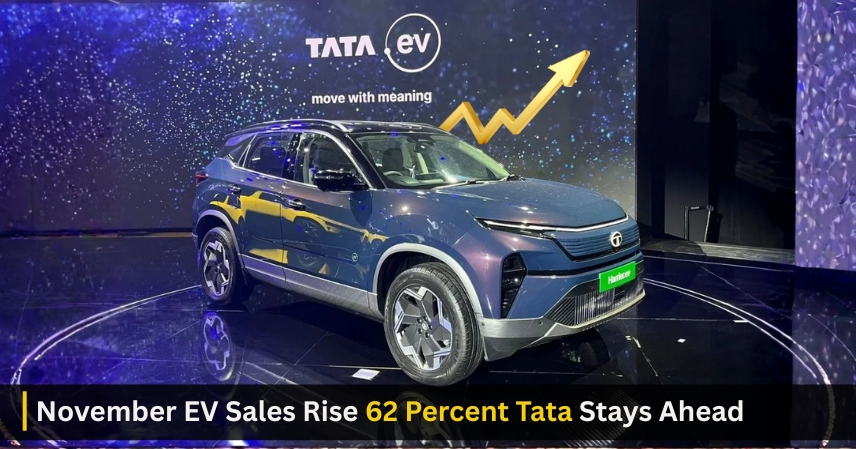
The electric vehicle (EV) market in India is experiencing unprecedented growth. November 2025 marked a milestone month, with EV sales soaring by 61.87% year-over-year, according to the latest FADA retail statistics. Increased consumer interest, improved financing, expanded battery and charging infrastructure, and a flurry of new model launches across all segments are fueling this remarkable transformation.
The Shift Toward Sustainable Transportation
India’s journey toward sustainable mobility is evolving from a niche interest to a mainstream movement. In November 2025 alone, a record 14,850 EVs were sold. Tata Motors continues to dominate the passenger vehicle (PV) EV market, leading in sales, customer trust, and model variety.
Market Expansion: Diverse EV Segments Available
The EV landscape now includes a wide range of options:
- 2-Wheelers (2W)
- 3-Wheelers (3W)
- 4-Wheelers (Passenger EVs)
- Buses
- Luxury EVs
- Commercial EVs
However, the PV EV segment stood out as the primary growth driver in November.
Key Sales Highlights: November 2025
- Total EVs Sold: 14,850
- Year-on-Year Growth: 61.87%
- Month-on-Month Growth: 17.75%
- EV Share in PV Market: 3.8% (up from 3.3% in October)
This surge underlines the growing willingness of Indian consumers to invest in EVs for long-term value, technological upgrades, and reduced operating costs.
Real-World Impact: How EV Growth is Changing Lives
What’s Driving EV Adoption?
- Affordable EV Options: Compact models from Tata, MG, Mahindra, and Hyundai attract first-time buyers.
- Enhanced Charging Network: Expanding DC fast charger networks are easing range anxiety.
- Rising Fuel Prices: Lower running costs make EVs attractive for daily commutes.
- Improved Battery Technology: Longer ranges (350–550 km), better durability, and performance in hot climates boost consumer confidence.
- Flexible Financing & Subscriptions: Easier loans and attractive financing from banks and NBFCs reduce upfront ownership costs.
OEM-Wise Performance: November 2025
Top EV OEMs
- Tata Motors: 6,153 units sold (+38.3% YoY)
- Models: Nexon EV, Punch EV, Tiago EV, Tigor EV, Harrier EV (premium segment)
- Strengths: Customer trust, wide dealer network, robust after-sales support, safety ratings
- MG Motor: 3,693 units sold
- Models: ZS EV, Comet EV
- Strengths: Reliable batteries, innovative interiors
- Mahindra: 2,966 units sold
- Models: XUV400, Newborn Electric platform, XUV 9S (upcoming)
- Strengths: Strong SUV loyalty
- Kia: 464 units sold (+527% YoY)
- Models: EV6, Carens EV (upcoming)
- Strengths: Growing youth appeal
- Hyundai: 372 units sold (+171% YoY)
- Models: Kona Electric, Ioniq 5, Creta EV, Venue EV (upcoming)
- Strengths: Design, brand trust, range
- BYD India: 425 units sold (+15.8% YoY)
- Models: Atto 3, Seal EV
- Strengths: Blade battery technology, fleet/high-end market presence
- VinFast: 291 units (New entrant)
- Strengths: Affordable, fast-charging, city-friendly design
Market Insights: Why Are EV Sales Up 62%?
- Urban Adoption: Corporate fleets, ride-hailing, and eco-conscious consumers are propelling growth in major metros.
- Expanding Model Range: More hatchbacks, SUVs, luxury, and commercial EVs are available.
- Easier Financing: Lower interest rates, longer tenures, and EV-specific loan schemes.
- Improved Charging Infrastructure: More public chargers are reducing range anxiety.
- Lower Battery Costs: Falling lithium prices are reducing EV production costs.
Segment-Wise Trends: November 2025
Passenger EVs Lead the Charge
- SUVs and compact EVs drive the surge.
- Luxury EVs (e.g., Mercedes-Benz, BMW) are gaining traction among wealthy buyers.
Two-Wheeler EVs: Temporary Slowdown
- 2W EV sales dipped by 2.15% post-festive season.
- Reasons: Price sensitivity and battery replacement costs.
Fleet and Commercial EVs: Rising Popularity
- Logistics and commercial sectors are increasingly adopting EVs due to lower operating costs.
Looking Ahead: The Future of EVs in India Post-2026
Expected Growth Drivers
- New Launches: Mahindra XUV 9S, Maruti eVitara, Tata Sierra EV, new models from Hyundai, MG, and VinFast.
- Government Support: PM E-Drive incentives, 72,000 new chargers, reduced GST on EVs, state subsidies.
- Technological Advancements: Improved battery chemistry, faster charging (up to 180kW), advanced infotainment, ADAS features.
Analysts forecast even faster EV adoption in 2026 and beyond.
Why Tata Motors Remains India's Leading EV Brand
Tata Motors maintains its lead due to:
- Competitive pricing (₹10–20 lakh range)
- Largest EV dealer network
- High safety (5-star ratings)
- India-specific battery performance
- Strong customer service and after-sales support
- Easy home-charging solutions
- First-mover advantage and brand trust
Conclusion
November 2025 was a landmark month for EV sales in India, with the sector growing by 62% from the previous year. Tata Motors remains the market leader, but brands like MG, Mahindra, Hyundai, Kia, BYD, and VinFast are rapidly closing the gap with an array of new, technology-driven models. Supported by government incentives, falling battery prices, and expanding infrastructure, India’s transition to electric mobility is set to accelerate further in 2026.
FAQs
14,850 EVs sold, a 61.87% increase year-over-year.
Tata Motors, with 6,153 units.
EVs now represent 3.8% of all passenger vehicles, up from 3.3% in October.
Kia, Hyundai, BMW, and newcomer VinFast.
Yes. More launches, better charging infrastructure, and decreasing battery costs are expected to accelerate adoption.